
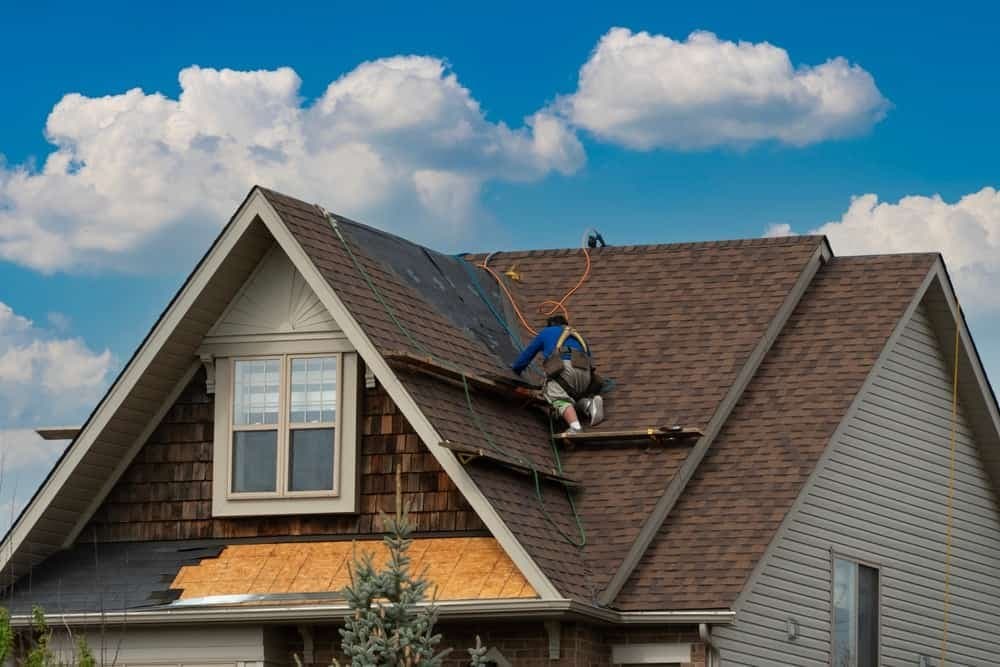
What drives the cost of a roof repair or replacement? Six things: the size of the roof, its pitch, how many layers of old roofing have to come off, the condition of the decking underneath, the number of valleys, chimneys and penetrations that need flashing, and whether the attic ventilation needs correcting while the roof is open. Square footage alone tells you very little — a steep, cut-up roof takes far longer to strip and detail than a simple gable of the same area. The costs that surprise homeowners are almost always decking replacement, which nobody can see until the tear-off, and ventilation work. A quote given over the phone cannot know either, which is why it changes once the crew arrives.
Chad Erickson founded Total Home Exteriors in Andover, MN in 2003 and still walks every insurance claim personally. Last updated: September 2026.
What are the hidden costs of a roof repair?
Decking replacement and ventilation work. Neither is visible until the old roofing comes off, and both are common on older Minnesota roofs. A written estimate should state how decking repair is priced before work starts, so a genuine find is not an argument later.
Why do roofing quotes vary so much?
Because they are often quoting different jobs. A cheaper bid may assume a lower-grade shingle, the code-minimum strip of ice-and-water shield rather than full eave coverage, no ventilation work, and no allowance for decking. Compare the scope, not just the total.
Is the cheapest roofing quote ever the right one?
Sometimes, but only when it covers the same scope as the others. If it is cheaper because it skips ice-and-water coverage at the eaves or ignores a ventilation problem, you are deferring cost rather than saving it — and in Minnesota that deferral usually shows up as ice dams.
What actually moves the price of a roof
Roofers price from squares — 100 square feet of roof area — but the multiplier on each square varies enormously with these factors:
- Pitch. A steep roof needs staging and fall protection and cannot be walked freely, which slows every stage of the work.
- Tear-off layers. Two or three existing layers means twice the disposal volume and considerably more labour than one.
- Decking condition. Rotted or delaminated sheathing must be replaced before new roofing goes down. It cannot be assessed until tear-off.
- Complexity. Valleys, dormers, chimneys, skylights and vents each need flashing, and flashing is where the labour and the leaks both live.
- Ventilation. If the attic is not breathing, correcting it while the roof is open is far cheaper than doing it later.
How to read a roofing estimate properly
A real estimate names the shingle line and its warranty, the underlayment, how much ice-and-water shield goes at the eaves and in the valleys, what ventilation work is included, how decking repair is priced per sheet if it is needed, and who carries the workmanship warranty and for how long.
If a quote is a single number with no scope behind it, you cannot compare it to anything. Ask for the line items — a contractor who will not put them in writing is telling you something useful.
Where homeowners genuinely save, and where they only defer
Real savings come from timing and scope: booking outside the post-storm rush when schedules are congested, combining the roof with gutters so one crew handles both, and choosing a mid-grade architectural shingle rather than a premium line whose extra warranty years you may never use.
False savings come from skipping the parts you cannot see. Reducing ice-and-water shield coverage, skipping ventilation correction, and reusing flashing rather than replacing it all lower the quote and raise the odds you pay again within a few winters. In this climate those three are where roofs actually fail.
Related reading
Frequently asked questions
Does homeowners insurance pay for a roof that is just old?
No. Policies cover sudden damage from a specific event — hail, wind, a fallen tree — not deterioration from age. If a storm damaged an older roof there may well be a claim; a roof that has simply reached the end of its service life is a maintenance expense. A free inspection tells you which situation you are in before you file anything.
Should I repair now or save for a full replacement?
It depends on the roof's age and how far the damage spreads. Under about fifteen years with contained damage, repair is usually the sound call. Past fifteen with damage on more than one slope, repeated patching tends to buy a season or two and you pay for the tear-off anyway. Water getting in changes the maths — that never waits.
Is financing available for a new roof?
Yes. Total Home Exteriors offers financing through Synchrony Financial. Terms vary by applicant, so read the terms on any offer carefully — a low monthly figure over a long term can cost considerably more than it first appears.
Why did my roofer find rotten decking mid-job?
Because nobody can see the decking until the old roofing is off. It is the single most common mid-job find on older Minnesota homes, usually around chimneys, valleys and eaves where water has been getting in slowly. What matters is that the estimate told you in advance how it would be priced.
Have Questions?
Our team is happy to answer questions about any service — no sales pressure.
Related Articles
Take Action Today
Serving the Twin Cities for 20+ Years
Licensed, insured, and ready to help with your next exterior project.