
Emergency Roof Repairs: What to Do When You Can’t Wait for Regular Service!
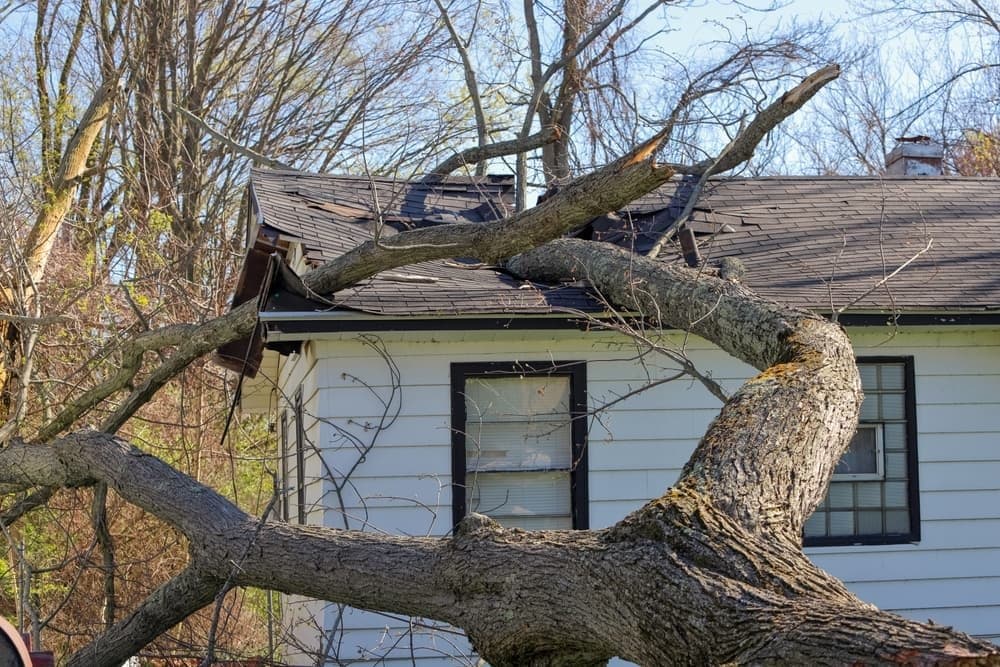
What do you do when your roof cannot wait? Stop the water getting in, then document before you repair. If the roof is open, call for an emergency tarp — insurers generally require you to take reasonable steps to prevent further loss, so tarping is expected of you, not held against you. Move belongings out from under the leak and put a container down, and if the ceiling is bulging with trapped water, pierce it deliberately at the lowest point to drain it in one place rather than letting it spread and collapse. Photograph everything from ground level with the date. Do not climb onto a wet or storm-damaged roof — that is how people get badly hurt, and the inspection can wait for someone with fall protection.
Chad Erickson founded Total Home Exteriors in Andover, MN in 2003 and still walks every insurance claim personally. Last updated: September 2026.
What counts as a roofing emergency?
Active water entry, a roof opened by wind or a fallen branch, or a ceiling sagging with trapped water. Anything letting water into the structure is urgent, because secondary damage to decking, insulation and framing usually costs more than the original loss.
What should I do while I wait for a roofer?
Move belongings clear, contain the water, and if a ceiling is bulging, pierce it at the lowest point to drain it in one controlled place. Photograph everything with a date. Stay off the roof.
Will emergency tarping affect my insurance claim?
Positively, if anything. Most policies require you to take reasonable steps to prevent further loss after an event, so tarping is what your insurer expects. Keep the receipt — mitigation costs are often reimbursable as part of the claim.
Why secondary damage costs more than the storm
Wind takes shingles off in ten minutes. The rain then works on the decking, the insulation, the drywall and the framing for however many days it takes to get the roof closed. Very often that second phase costs more to put right than the original damage did.
Wet blown insulation stops insulating and generally has to be removed and replaced. Saturated decking loses strength. Drywall stains, then sags. None of that is visible from the driveway, which is why speed matters more than the size of the hole.
What emergency tarping actually involves
A proper tarp is not a sheet weighted with bricks. It is secured over the damaged area and anchored so wind cannot lift it, extended past the damage in every direction, and lapped so water runs over it rather than under. Done properly it will hold through repeated Minnesota weather until permanent repair.
It is a temporary measure and it is meant to be. The point is to stop the loss growing while the claim is filed, the adjuster visits, and materials are scheduled.
How fast can a roof actually be repaired?
The tarp goes on straight away. The permanent repair depends mostly on the insurance timeline rather than the roofer: filing, the adjuster's visit, agreeing a scope, and approval account for most of the elapsed time, and that varies by carrier and by how many homes in the region were hit at once.
Once a scope is approved, the physical work on a typical house is measured in days. A contractor should tell you which part of the wait is them and which part is the claim — you should never have to guess where your job stands.
Related reading
Frequently asked questions
Should I pierce a bulging ceiling?
Yes, carefully, at the lowest point of the bulge with a container underneath. A ceiling holding trapped water will eventually fail on its own, and when it does it comes down across the whole area at once. Draining it in one controlled place limits the damage to a patch rather than a full ceiling replacement.
Can I tarp the roof myself?
We would strongly advise against it. Wet and storm-damaged roofs are slick, structural damage is not always visible from above, and ladder falls in bad weather cause serious injuries every year. If the roof is accessible only by ladder, wait for someone with proper fall protection.
Do you charge extra for emergency call-outs?
Ask us directly for your situation rather than assuming — pricing depends on timing and what the response involves. What we will say is that stopping water entry quickly nearly always costs less than the interior damage it prevents.
What if the leak stops on its own?
It has not stopped, it has paused — leaks track with rain direction and wind, so a leak that vanishes has usually just stopped being fed from that angle. Get it inspected while you know roughly where the water came in. Chasing a leak later, with no active water to follow, is considerably harder.
Have Questions?
Our team is happy to answer questions about any service — no sales pressure.
Related Articles
Take Action Today
Serving the Twin Cities for 20+ Years
Licensed, insured, and ready to help with your next exterior project.