
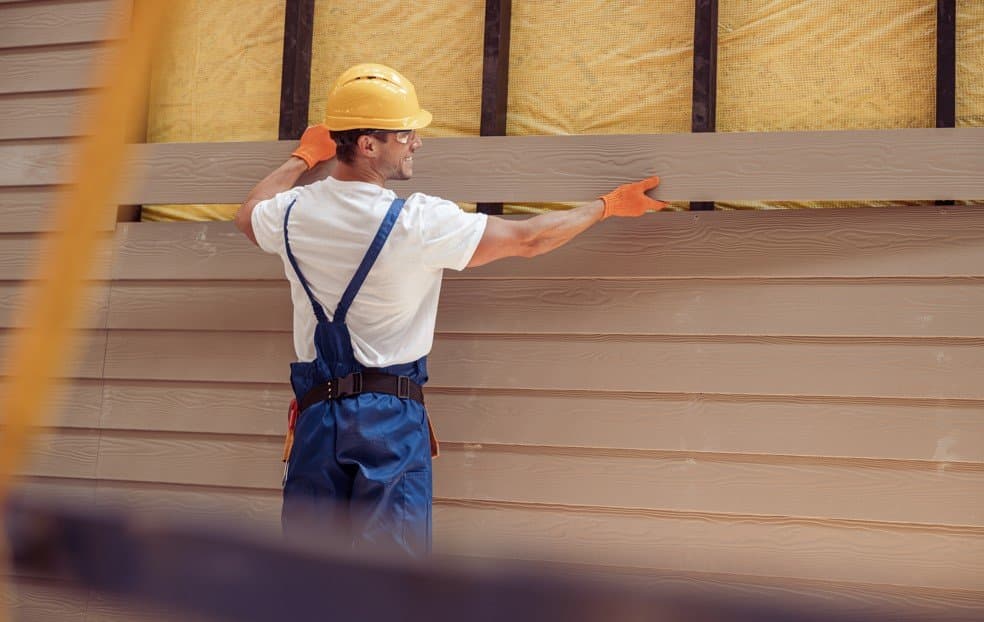
How do you choose siding for a Minnesota home? Weigh four materials against freeze-thaw durability, maintenance and cost. Fiber cement is the strongest all-round choice here — it does not warp or crack through freeze-thaw cycling, holds paint for a long time and resists pests, at the cost of being heavy and needing a crew that knows how to hang it. Vinyl is the value option and performs well provided it is installed with proper expansion gaps, because it moves substantially between a January morning and a July afternoon. Engineered wood gives the look of real wood with better moisture stability. Steel is worth considering where hail is a repeated problem. Most failed vinyl we replace failed on installation, not on material.
Chad Erickson founded Total Home Exteriors in Andover, MN in 2003 and still walks every insurance claim personally. Last updated: September 2026.
What is the best siding for a Minnesota home?
Fiber cement, for most homes. It resists the freeze-thaw cracking that splits lesser materials, holds paint far longer than wood, and is not attractive to pests. Vinyl is the value alternative and works well when installed with correct expansion allowance.
How long does siding last?
Vinyl commonly gives 20 to 40 years depending on grade and installation, fiber cement several decades with periodic repainting, engineered wood somewhat less, and steel the longest. In every case installation quality and flashing detail matter more than the material's rated life.
Do I need to replace all my siding or can it be repaired?
Repair when damage is localised — a few panels cracked by a ladder or branch, one rotted section of trim. Replace when problems repeat across elevations: widespread warping, soft or rotted board, chalky fading that no longer takes paint, or water finding its way behind the cladding.
Why most siding failures are installation failures
Vinyl expands and contracts a remarkable amount across a Minnesota year. It is designed to hang loosely on its nails so it can move; nailed tight, it has nowhere to go and buckles into visible waves within a couple of seasons. That is not a defect in the material, and replacing it with more vinyl installed the same way produces the same result.
The other failure mode is flashing. Siding that looks perfect but is badly flashed at a window head, a deck ledger or a roof-to-wall intersection will let water behind it, and you will not know until the sheathing or framing is damaged. Flashing detail is where siding jobs are genuinely won or lost.
What happens behind the siding matters more than the colour
When old cladding comes off, what is underneath tells you the real story: the sheathing, the house wrap, and whether water has been getting in. Covering compromised sheathing with new siding hides the problem for a few years while it keeps progressing.
A proper re-side inspects the wall assembly, replaces anything that has failed, installs a functioning weather-resistive barrier, and only then hangs the new material. Anyone quoting a re-side without mentioning what happens if they find damage underneath has not thought about it.
Choosing a colour and profile you will still like
Profile matters more than most homeowners expect. Lap siding, board and batten, shake and vertical panel each read very differently, and a profile that fights the architecture is noticeable from the street in a way a colour rarely is.
On colour, look at large samples on the actual wall in daylight rather than at chips indoors. Minnesota light is different in February and July, and a colour chosen under showroom lighting frequently reads quite differently on a north elevation in winter.
Siding materials compared for Minnesota
| Material | Freeze-thaw | Maintenance | Watch out for |
|---|---|---|---|
| Fiber cement | Excellent | Repaint on a long cycle | Weight; needs an experienced crew |
| Vinyl | Good if installed correctly | Essentially none | Buckling when nailed without expansion gaps |
| Engineered wood | Good | Periodic repaint or seal | Moisture at ground level and cut ends |
| Steel | Excellent | Very low | Cost; colour matching on repairs |
Related reading
Frequently asked questions
Can siding be installed in winter in Minnesota?
It depends on the material. Vinyl becomes brittle in deep cold and is best left for milder weather, since cutting and nailing it below freezing risks cracking. Fiber cement and steel tolerate a much wider range and are routinely installed through the colder months. If your siding is actively letting water in, waiting until June is usually the wrong call.
Does new siding add insulation value?
Very little on its own. Insulated vinyl siding and rigid foam sheathing installed under the cladding do add measurable R-value, and a re-side is a sensible moment to add exterior insulation since the walls are already open. But siding is not a substitute for attic insulation, which returns considerably more per dollar in this climate.
Will new siding increase my home's value?
Siding consistently ranks among the better-returning exterior improvements, largely because it changes the whole appearance of the house and signals that the envelope has been maintained. The return varies with material, neighbourhood and what you are replacing, so treat national averages as a rough guide rather than a promise.
How do I know if water is getting behind my siding?
Look for staining or streaking below windows and at wall penetrations, soft or spongy spots when you press on trim near grade, peeling interior paint or damp drywall on outside walls, and any musty smell in rooms with exterior walls. Any of those warrant opening up a section to look rather than guessing.
Have Questions?
Our team is happy to answer questions about any service — no sales pressure.
Take Action Today
Serving the Twin Cities for 20+ Years
Licensed, insured, and ready to help with your next exterior project.